US invasion makes L. America volatile







The year 2026 has certainly begun with a bang! The US administration's illegal invasion of Venezuela and capture of Venezuelan President Nicolás Maduro and his wife Cilia Flores on, as yet, trumped up, unsubstantiated charges, are symptomatic of the United States' Monroe Doctrine of 1823 — a US foreign policy named after former president James Monroe that viewed Latin America as the US' exclusive sphere of influence — and the days of earlier US gunboat imperialism that warned European powers to stay away from the Americas, because it defined the entire hemisphere to be in the US' sphere of influence.
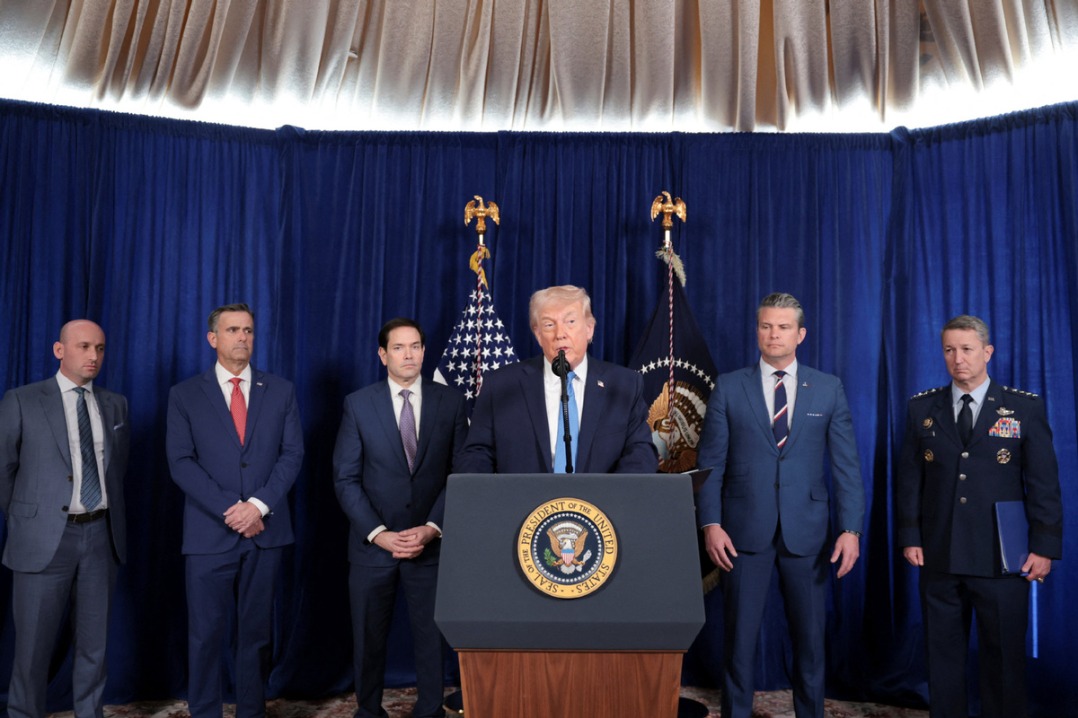
The US' intervention in Venezuela and likely future ones in the region were made clear in US President Donald Trump's 2025 National Security Strategy released on Dec 4, which established what it calls the "Trump Corollary" to the Monroe Doctrine. The NSS asserts that the US must be "preeminent in the Western Hemisphere as a condition for our security and prosperity", allowing the US to "assert ourselves with confidence where and when necessary".
The NSS framework prioritizes several relevant objectives: controlling critical supply chains, ensuring continued access to key strategic locations, preventing "hostile foreign incursions", defeating drug cartels that they've classified, without evidence, as terrorist organizations, stopping "illegal and destabilizing migration", and countering Chinese and Russian influence in the region.
The NSS strategy crows that "the military system superior to any other country in the world" would be used to gain access to the region's energy and mineral resources.
This represents a seismic shift. Recent US administrations generally relied on agreements, benefits and occasional coercion. Now the emphasis seems to be on outright domination through military force, tariff wars and interventions without regard to international law.
Will the US administration stop at Venezuela? The US invasion of a sovereign nation has violated international law and endangered other Latin American countries. The US president has already sent warnings to other countries including Cuba.
Cuba represents a high-probability target. US Secretary of State Marco Rubio's father was a Cuban exile, and like most former Cubans in the US and their families, Rubio viscerally detests Fidel Castro's 1959 victory. Cuba's long-standing adversarial relationship with the US, its close alliance with both Venezuela and Nicaragua, and its support for Maduro's regime provide clear motivations for US intervention.
Nicaragua? Rubio has also explicitly designated the husband-and-wife Daniel Ortega-Rosario Murillo regime as an "enemy of humanity", placing it in the same category as Venezuela and Cuba. In fact, during his February 2025 visit to Central America, Rubio emphasized that Trump opposes the "regimes" of Maduro, Miguel Díaz-Canel in Cuba, and Ortega-Murillo in Nicaragua, describing these three governments as responsible for creating the US immigration crisis.
President Gustavo Petro in neighboring Colombia, announced that security forces were deployed along the border to prepare for a possible refugee influx. Petro condemned the attack as an aggression against Venezuela and Latin America, urging de-escalation.
Ancient Roman emperors used bread and circuses to divert attention from political failures and misadventures. Modern politicians have often used wars to deflect attention from their shortcomings in what's termed a diversionary "wag the dog" strategy. With domestic opposition growing in the run-up to congressional, state and local elections in November, the US administration may just be beginning to borrow a page from this strategic playbook.
The author is a US scholar and a senior fellow at the Center for China and Globalization.
The views don't necessarily represent those of China Daily.
If you have a specific expertise, or would like to share your thought about our stories, then send us your writings at opinion@chinadaily.com.cn, and comment@chinadaily.com.cn.