|
|
 |
 Raymond Zhou:
By jingo, they're mad!  Op Rana:
Consumerism and politics of waste   Ravi S. Narasimhan:
Lessons from SARS have to be applied  Alexis Hooi:
Beyond the death and destruction  My slow journey into China's past
By Jules Quartly (China Daily)
Updated: 2008-12-19 08:02
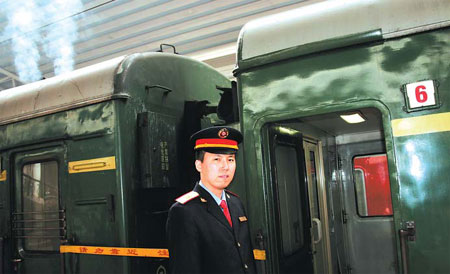
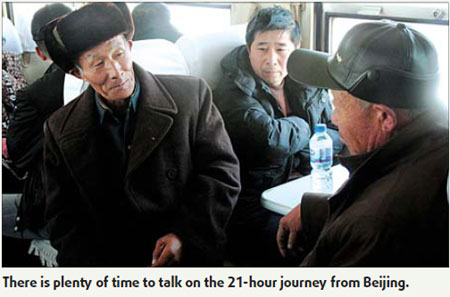
The retired food factory workers, both 66, rarely travel but Liu needed to see the dentist. He opened his mouth and pulled on his upper lip to expose sepia-colored teeth and a gap where the incisor should have been. It had broken off and the stump was still visible. Slow trains like the 2251 from Beijing to Dandong are a lifeline for people like Liu. He said there's no dentist in Qijiabao, a small town in Liaoning, nor buses, and he never learned to drive a car. The train is cheap and convenient. His wife nodded in agreement all the while, smiling but mute. Thousands of people depend daily on this slow train and others like it, but it's part of a vanishing network as a new round of rail modernizations replaces them. It was as if we were journeying into the past when our diesel-powered train puffed out of Beijing Railway Station at 12:20 pm on a recent weekday, packed with migrant workers, flush with cash and alcohol. The 23-year-old locomotive rattled along at just 60-80 km/h. When the tracks ran parallel to the road, cars zipped by and even buses steadily pulled away from us. The journey would take 21 hours 22 minutes, stop at 21 stations and cover 1,166 km. All for the bargain price of 147 yuan ($21).
On the 16 carriages, including a mail van, there appeared to be six classes of temporary accommodations. At the bottom end was standing. Young farmer, Po Ting, said he was returning to Liaoning after visiting Beijing for the first time. He leaned against the wall in one of the gangways between the carriages, playing Taoist mantras on his mobile phone at maximum distortion. Others sat glumly on their bundles near the doors. A pair of lovers whiled away their journey in the dining car, shared a bottle of water, stroked each other's hair and took turns to sleep. Toward the end of the journey staff and vendors congregated out of uniform in the diner to chat and count the money they had made by selling sunflower seeds, packed meals and xuegao ice-lollies. Hard-seating class was like a club - loud, lively and smoky. Extended families made the most of their confinement by snacking, drinking and socializing. Soft seating was much the same, but the air was fresher and there were fewer people. I was in hard sleeper with six bunks in a space little larger than two office cubicles. At the top there wasn't enough headroom to sit up straight, so I unpacked semi-reclining. Otherwise, it was relatively comfortable. Actually, the beds are not that hard and the bedding was clean. I was sharing with a married couple and their 15-month-old kid, who thankfully turned out to be one of the quietest people on the train. Another couple bunked below me and it wasn't until about 9 pm that a teenager climbed into the empty bed opposite. Before long he was sobbing and when I looked over he was cradling his mobile phone, with his back to me, telling the girl on the other end not to cry. The tragedy continued. His message alert was a machine gun sound and throughout the long night there was continuous fire. Love is, sometimes, a battle. Soft sleeper was more spacious, with a door and just four bunks to a room. At the top of the train was a carriage from which I was barred, but I nevertheless returned a little later for a sneak peak. A small group of men had the car to themselves and were toasting each other. A guard later told me they were "lingdao", top officials or businessmen. As the light outside faded to black, the music in our compartment changed from patriotic songs, to pop ballads and finally ambient/religious music, before the strip lights were extinguished at 9:30 pm. They came back on at 6:30 am. At 3 am, however, I needed the bathroom and felt it was my duty to scout around. The toilets were steel-rimmed holes and it was forbidden to use them at stations. They were simple but serviceable and showed signs of being cleaned. Hard and soft seating had emptied a bit and some passengers spread their lengths across the seats. A family dressed in matching black leather coats boarded in Fuxin and arranged themselves on the seats outside our hard sleeper compartment. They struck up a conversation with a solicitor called Gong Guanchi, from Chaoyang, who had got on three hours previously. He has a practice in Dandong and works there six days a week, returning home for three days off. I said it seemed like a long commute (610 km) but he shrugged his shoulders. Taking this train allows him to arrive early enough to work a whole day in the office. He appeared to have no trouble sleeping in a sitting position. We arrived on time in Dandong at 9:42 am. I've been told a couple of times the best way to experience China is to take a slow train to some far-off destination. Instead of the countryside flashing by there's time to watch it unfold and you have little choice but to serendipitously befriend people you wouldn't normally meet. It's true.
|
主站蜘蛛池模板: 孟州市| 锡林郭勒盟| 鹰潭市| 嘉黎县| 格尔木市| 绥芬河市| 河东区| 岚皋县| 金门县| 时尚| 蕲春县| 墨江| 肇庆市| 阿克陶县| 汉寿县| 临城县| 朝阳县| 昭通市| 香格里拉县| 平遥县| 永修县| 中阳县| 武川县| 德昌县| 沈丘县| 南安市| 司法| 玉环县| 宜良县| 佛冈县| 五寨县| 涟源市| 双桥区| 庆城县| 葫芦岛市| 崇文区| 普兰县| 沂源县| 金山区| 英超| 酒泉市| 临朐县| 鄂托克前旗| 长春市| 车致| 遵义市| 阿鲁科尔沁旗| 吕梁市| 仲巴县| 建昌县| 通州市| 武汉市| 西昌市| 清苑县| 甘南县| 大兴区| 临泉县| 潢川县| 武山县| 游戏| 黄陵县| 水富县| 桐乡市| 桐庐县| 白沙| 广昌县| 郁南县| 荃湾区| 灵川县| 南岸区| 阜平县| 永宁县| 海安县| 卓资县| 定陶县| 太白县| 孝感市| 衡东县| 阜城县| 嘉峪关市| 中西区| 九龙县|