 |
|
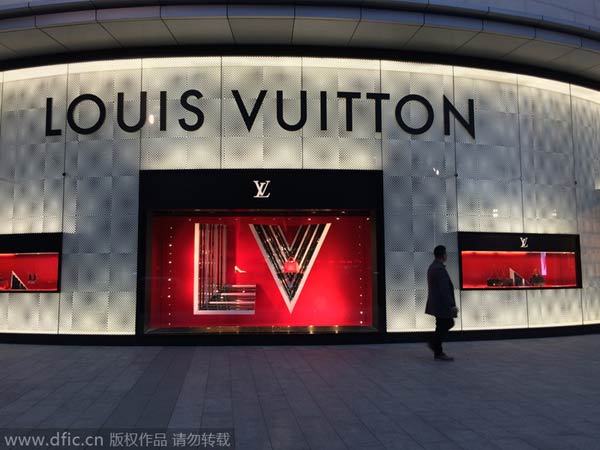
A pedestrian walks past a Louis Vuitton boutique of LVMH Moet Hennessy Louis Vuitton SA at a shopping mall in Fuzhou city, East China's Fujian province, Jan 30,?2015. [Photo/IC] |
Fortune Character Institute's 2014 China Luxury Report found that 76 percent of Chinese luxury consumption occurred overseas last year, and that raises many questions. Are import duties too high? Is the anti-corruption drive simply too much? Are there too many fake products in China? Are Chinese luxury shops destined to be venues for bad shopping experiences? Whatever answers you come up with for these questions, it has to be said that the real problem at the heart of this overseas spending is a Chinese character trait: a lack of confidence.
All consumption is generally influenced by two things: the ability to consume and the psychology of consumption. As overall consumption increases, the ability to consume grows and the psychology of the consumer matures.
Many macro factors can affect consumption, such as exchange rates, tariffs and domestic policy, but generally none of these holds absolute sway.
If the capacity of Chinese people to be consumers is problematic, you would think it would have been impossible for them to be responsible for buying 46 percent of luxury goods worldwide. China has a history and culture of 5,000 years, so there is no lack of high-quality products and technology, but Chinese people have a very high regard for exotic luxuries, which is why they spend so wildly when they are overseas.
Why? The answer is consumer psychology. The core expression of this is that China consumers lack self-confidence.
China went through thousands of years as a feudal society. A feeling of inferiority is the norm, as is a strong desire to attain the status of nobility. When that desire cannot be satisfied emotionally and spiritually, luxury is undoubtedly the best way to identify people's status and wealth. As ludicrous as that may seem to the casual observer, many people in China - intentionally or otherwise - do exactly that.
This diffidence has been developed to another level: living abroad and consuming abroad, which have become almost a fashion statement, a way of standing out from the crowd.
Another psychological reason for Chinese lapping up luxury goods overseas is their lack of confidence in their country.
Before China launched the reform and opening-up policy in late 1970s, China has long lagged behind developed countries in political, social and economic development. It has been relatively simple to catch up economically in a short time, but very difficult to effect a psychological transformation. The country has, of course, made huge strides with its policies of reform and opening-up over little more than 30 years to become a world power, but this newfound economic power has not delivered Chinese a strong national consciousness, so they still lack self-assuredness.
These days Chinese people always seem to be in search of foreign products. Most think Chinese products cannot possibly hold their own with foreign products. They do not think China can have its own luxury brands and do not believe anyone can enjoy the luxury goods consumption experience in China.
If you couple that with tariffs, exchange rates and luxury brands' ability to appeal to that kind of mindset, it is hardly surprising that 76 percent of Chinese luxury consumption occurred overseas last year. How sad is it then that even though Chinese people know many international products are made in China, that they pay too much as a brand premium, and that they know many Chinese products are superior to foreign brands, they are still willing to rush off abroad in the pursuit of overseas luxury.
The anti-corruption drive at home obviously is not going to stamp out the desire for luxury goods. On the contrary, it encourages Chinese people to do their luxury buying overseas. If Chinese people felt confident enough of their own country, its products and their own culture, it is unlikely foreign luxury brands would have such an easy run.
The author is dean of Fortune Character Institute. The views do not necessarily reflect those of China Daily.

Copyright 1995 - . All rights reserved. The content (including but not limited to text, photo, multimedia information, etc) published in this site belongs to China Daily Information Co (CDIC). Without written authorization from CDIC, such content shall not be republished or used in any form. Note: Browsers with 1024*768 or higher resolution are suggested for this site.
License for publishing multimedia online 0108263 Registration Number: 130349