Hong Kong was not a healthy place in the late 19th century. For decades after the British founded the colony in 1842, the Chinese settlement of Sheung Wan struggled with overcrowding and chronic disease.
|
 |
|
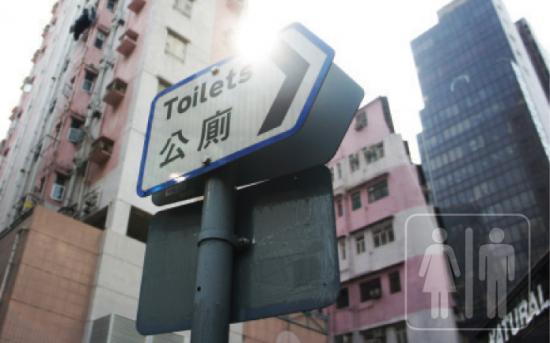
A “five-star toilet” near tourist site Lam Tsuen Wishing Tree, where a HK$2.8 million was spent. The government has been criticized for spending too much on Hong Kong’s public toilets. (Mok Kwok-cheong / China Daily) |
Things were especially bad in Tai Ping Shan, a hillside enclave of tenement houses packed with coolies who worked as manual laborers. In 1881, the colonial government hired Oswald Chadwick, a British engineer, to conduct a survey of the district's homes. He was alarmed by what he found. In some buildings, 80 tenants crammed into a single flat. People shared space with chickens and pigs. Drains were built haphazardly, so they clogged and became septic, toxic sludge leaking into the surrounding soil.
Chadwick was particularly appalled by the way human waste was handled. "As a general rule throughout Hong Kong, in accordance with time-honored Chinese practice, human excrete are removed by hand, on what may be called the 'pail' system," he wrote in his report, which was published in 1882. "Neither deodorisation or disinfection of any kind is attempted."
By contrast, the homes in Hong Kong's European districts were well-equipped with water closets attached to municipal drains. Such luxuries were not afforded to the fast-growing Chinese population, which was limited to cramped quarters like Tai Ping Shan because land use laws prohibited the expansion of tenement housing — a strategy used by the colonial government to keep the European and Chinese populations apart.
Public facilities were non-existent. Entrepreneurs took advantage of the situation by building public latrines — just 25 for a population of more than 100,000 — from which they made a hefty profit by selling human excrement as fertilizer. "On the whole the existing latrines are offensive and a nuisance, both as to position and construction, and they are so crowded as to render improvements to maintenance very difficult," wrote Chadwick.
Until then, nobody had made a direct link between Hong Kong's filth and any outbreak of disease, but Chadwick suggested that an epidemic of some sort was inevitable. "He predicted that if there was an outbreak, it would be a disaster because sanitation was so bad," says Lau Kwok-wai, executive director of the Conservancy Association Centre for Heritage, which specializes in the history of Western District. "He was right."
In 1894, an outbreak of bubonic plague killed more than 3,000 people in Tai Ping Shan. In response, the government demolished the entire neighborhood and rebuilt it on a grid of streets surrounding Blake Garden, Hong Kong's first public park. In 1904, it opened Hong Kong's first public toilet and bathhouse on Pound Lane, with space for 28 men and 10 women.
For the first time, people who had been forced to live in their own filth "had a chance to clean themselves," says Lau. The toilet and bathhouse were immensely popular. Two decades after it opened, in 1926, the Pound Lane facility was used by 224,363 people — one out of three Hong Kong residents. "I spoke to some kaifong (neighborhood people) and they said that even in the 1960s they didn't have toilets," says Lau. "Everyone would queue up for the bathhouse at night."
Hong Kong was not unique in building a network of public toilets and bathhouses. By 1915, most British towns had at least one bathhouse. New York was notorious for its lack of public toilets; Author and playwriter Henry Miller once wrote, “I know that I am in distress when I walk the streets of New York. Wondering constantly where the next stop will be and if I can hold out that long.” But New York too invested in public facilities, opening 1,821 new toilets in parks and subway stations in the 1930s alone.
Where Hong Kong stands out is the way it has maintained and expanded its network of free, government-operated public toilets. Today, there are 1,606 toilets in Hong Kong's streets and parks, not including those operated by the MTR, shopping malls and privately-operated wet markets. By contrast, New York has almost entirely dismantled its network of public toilets, converting many into storage spaces and even shops, if they weren't simply sealed off and abandoned.
"Public toilets allow us all to get out of the house, stay out longer, go to new places and experiences greater freedom in work and leisure," says Gail Ramster, a design researcher at the Royal College of Art in London. "They're a public service that meets a public need."


Copyright 1995 - . All rights reserved. The content (including but not limited to text, photo, multimedia information, etc) published in this site belongs to China Daily Information Co (CDIC). Without written authorization from CDIC, such content shall not be republished or used in any form. Note: Browsers with 1024*768 or higher resolution are suggested for this site.
License for publishing multimedia online 0108263 Registration Number: 130349